Key takeaways
- Telehealth excels at ongoing, data-driven care: protocol management, follow-ups, prescription continuity and between-visit messaging.
- In-person care is irreplaceable for emergencies, hands-on physical exams, imaging and procedures — a good telehealth practice says so plainly.
- Hybrid care is the realistic model for most people: lab work serves as the objective bridge that gives a remote physician most of what an exam room provides.
- On cost and time, telehealth usually wins for routine and follow-up care — no commute, no waiting room, and transparent pricing.
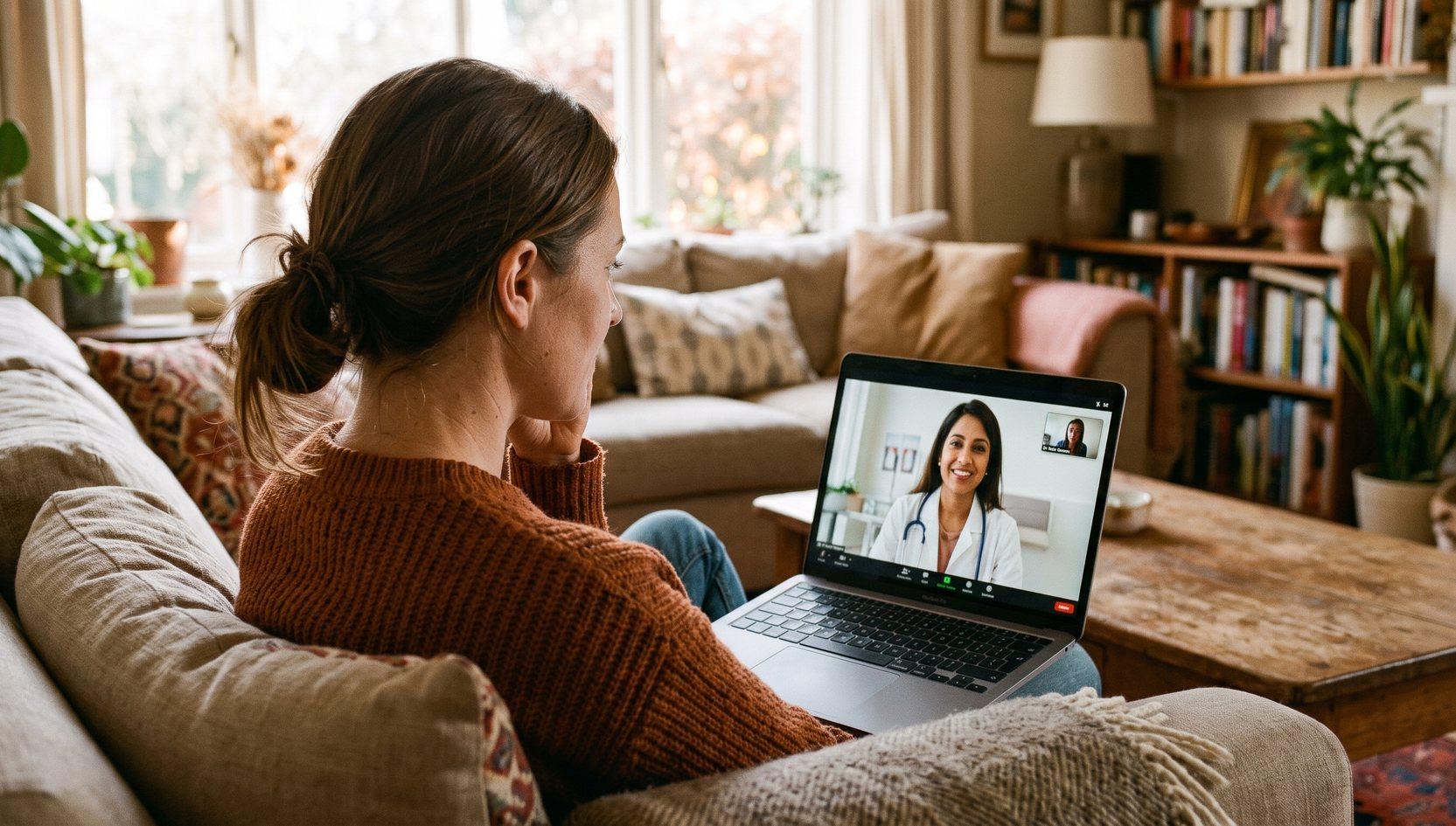
Telehealth and in-person care aren't competitors so much as tools for different jobs: telehealth excels at access, continuity and ongoing protocol management, while in-person care remains essential for emergencies, physical examinations and procedures. The right question isn't which one is 'better' — it's which one fits the kind of care you need right now.
This guide maps that honestly, from both directions. We're a telehealth practice, so you might expect cheerleading — but overselling remote care helps no one, least of all patients. What follows is where telehealth genuinely wins, where it genuinely doesn't, and how the hybrid model most people actually end up with uses lab work as the objective bridge between the two.
Where telehealth genuinely excels
Telehealth's core advantage is removing the friction that keeps people from getting care at all. No commute, no waiting room, no taking a half-day off work for a fifteen-minute conversation. For people in rural areas, with demanding schedules, or with mobility constraints, that's often the difference between managed health and unmanaged health.
Its second advantage is continuity. Ongoing protocols — weight programs, hormone support, preventive optimization — live and die on consistent follow-up, and follow-up is exactly what traditional scheduling makes hard. Telehealth flips that: check-ins are easy to keep, your physician has your full history and labs on screen, and asynchronous messaging means a question on Tuesday gets an answer without waiting for a March appointment. For medication management, e-prescribing to your pharmacy — including compounded prescriptions shipped to your door — closes the loop.
- Access — care that doesn't depend on geography, mobility or a flexible work schedule.
- Continuity — easier follow-ups mean protocols actually get monitored and adjusted.
- Messaging — questions answered between visits, not saved up for the next one.
- Privacy and comfort — some conversations are simply easier from your own home.
Where in-person care is necessary — full stop
Some care requires hands, equipment and physical presence, and no camera changes that. Emergencies lead the list: chest pain, difficulty breathing, severe injury, stroke symptoms — these are 911-and-emergency-room situations, never telehealth situations. Any remote provider who doesn't say that clearly and immediately should worry you.
Beyond emergencies, in-person care is the right setting for hands-on physical examinations, imaging, vaccinations, wound care, and procedures of any kind. Diagnosing a new, undifferentiated problem — abdominal pain, a lump, a concerning skin change — also often warrants an exam a screen can't perform. A trustworthy telehealth physician's job in those moments is triage and referral: recognizing what belongs in an exam room and sending you there without delay.
- Always in person: emergencies, physical exams, imaging, vaccinations, wound care, procedures.
- Often in person first: new undiagnosed symptoms that need hands-on assessment before anything else.
- The tell of a good remote practice: it refers you out quickly and specifically, rather than stretching video care past what video can do.
The hybrid model: labs as the objective bridge
Here's the part the 'telehealth vs. in-person' framing misses: most modern care is already hybrid, and the bridge between the two settings is objective data. A video visit can't palpate an abdomen — but paired with comprehensive blood work, it gives a physician most of what routine preventive and protocol care actually requires: your history, your symptoms, and dozens of measured values from a full biomarker panel.
In practice the loop looks like this: labs are collected at home or at a local draw site, a licensed physician reviews the results and meets you by video, a protocol starts (or doesn't — that's what evaluation means), and follow-up labs verify how your body is responding. The physical touchpoints — blood draws, an annual in-person physical, any needed imaging — slot into a care relationship that's otherwise continuous and remote. You keep your local doctor; telehealth handles the data-driven layer between visits. This is how our platform is built to work, and it's why we treat labs as the foundation rather than an add-on.
Notice what the labs are doing in that loop: they replace the subjective parts of a visit with measured ones. A physician who can see your biomarker trends alongside your reported symptoms is often better informed than one relying on an exam-room conversation alone — which is why data-driven remote care can be rigorous rather than a compromise.
Cost and time: the practical math
For routine and follow-up care, telehealth usually wins the practical math. An in-person visit costs more than its sticker price — the commute, the parking, the waiting room, the hours off work. Remote visits compress that to the visit itself, and transparent subscription pricing for protocol care replaces the surprise-bill model with a number you know in advance.
The honest caveats: complex diagnostic workups can cost more in total if telehealth becomes an extra step before an inevitable in-person referral — good triage exists precisely to prevent that. And insurance handling differs across telehealth providers, so 'cheaper' depends on your coverage and the care in question. The fair summary: for ongoing, protocol-based and preventive care, telehealth tends to save meaningful time and money; for procedures and complex diagnostics, in-person was always going to be the venue anyway.
How to choose for the situation in front of you
A simple way to decide: match the setting to the job. Emergencies and physical problems that need hands or equipment go in person, immediately. Ongoing management, prescription continuity, lab review, and lifestyle-adjacent protocols are telehealth's home turf. New symptoms that are concerning but not urgent can start remote — a physician can triage, order labs, and refer you onward if an exam is warranted.
It's also not a permanent choice. Plenty of patients start with a remote lab panel out of curiosity, discover something worth managing, and build a hybrid routine from there; others use telehealth only to keep an existing protocol steady between annual physicals. The settings are complements, not camps.
And whichever setting you choose, the quality markers are the same: licensed physicians, real evaluation before any prescription, plain answers about what the practice can and can't do. If you're still weighing whether remote prescribing is legitimate at all, we've written a direct answer in is telehealth legit? — the short version is that the medium matters far less than the medicine behind it.
Common questions
Is telehealth as good as seeing a doctor in person?
For the care it's suited to — follow-ups, protocol management, prescription continuity, lab review — research suggests outcomes are comparable, and adherence is often better because visits are easier to keep. For emergencies, physical exams and procedures, in-person care is necessary, and a trustworthy telehealth practice will say so plainly.
Can a telehealth doctor order blood work?
Yes. Licensed physicians on our platform order comprehensive panels collected at home or at a partner draw site near you, then review the results with you by video. Labs are the objective bridge that lets a remote physician make grounded decisions — it's why lab work anchors the evaluation process rather than being optional.
Do I still need a primary care doctor if I use telehealth?
We think you should keep one, honestly. A local physician covers annual physicals, hands-on exams and urgent needs, while telehealth handles the continuous, data-driven layer — protocols, follow-ups, messaging and lab trends. The two complement each other, and good telehealth care coordinates with in-person care rather than replacing it.
This article is for general education and is not medical advice. Protocols described here require an online consultation with a licensed provider who will determine if a prescription is appropriate for you. Explore telehealth options or read the FAQ.