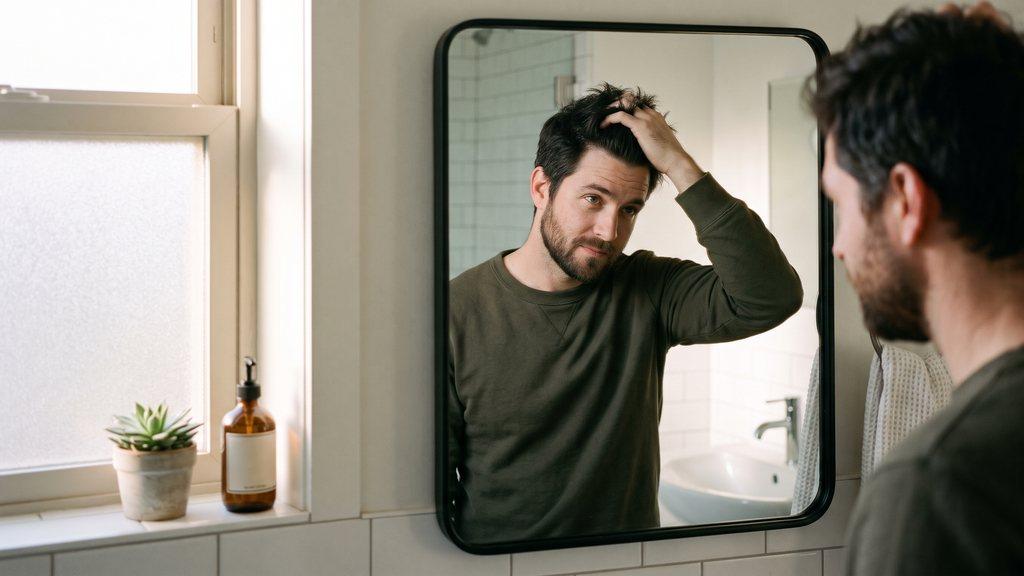
Hair Progress Photos: How to Track Treatment Honestly
Key takeaways
- Consistent photos are the most practical way to judge hair treatment, because day-to-day mirror checks miss slow change and exaggerate bad days.
- Fix everything you can: the same spot, light, distance, phone lens, time of day and hair state for every session.
- Shoot five views: front hairline, both temples, the top of the scalp, the crown and, for women especially, the part line.
- Monthly is enough. Compare like with like at 3, 6 and 12 months, and treat stability as a result in a condition that otherwise progresses.
- Store the photos privately and share them only through a secure patient portal.
The best way to take hair progress photos is to build one fixed setup, same place, same light, same distance, same hair state, and shoot the same five views once a month. Hair changes too slowly to judge in a mirror, and small differences in lighting or styling can make the same scalp look thicker or thinner from one day to the next. A consistent photo series removes most of that noise.
This guide covers the setup, the views that matter for pattern hair loss in men and women, how to handle wet hair and haircuts, what to compare at each milestone, how to keep the images private, and how a provider uses them. For how long each treatment usually takes to show change, see how long finasteride and minoxidil take.
Why photos beat the mirror
Pattern hair loss and its treatment both play out over months. In the mirror you see your scalp every day, under different light, after different products, and in whatever mood the morning brings. The change you are looking for is smaller than those swings. Photos taken the same way each time let you compare month one with month six directly, which is how clinicians judge it too.
Hair specialists rely on standardized global photographs, meaning whole-scalp images taken from fixed angles under controlled conditions. A practice guide on standard procedures in trichology recommends follow-up at 3, 6 and 12 months with global photographic assessment, and notes that seeing progress helps people stick with treatment. Clinical trials of hair-loss medicines use the same idea, scoring standardized photos alongside hair counts. You can borrow the method at home without special equipment.
How do you set up consistent hair photos?
Spend ten minutes getting the setup right once, then write it down so every later session copies it. The goal is that the only thing that changes between photos is your hair.
- Light: choose one spot and one light source and always use it. Soft, even light from in front works best. Strong overhead light makes any scalp look thinner on top, and a window changes with weather and season, so a fixed lamp or ring light is more reliable.
- Flash: pick one rule, always on or always off, and keep it. Flash shows more scalp than room light does.
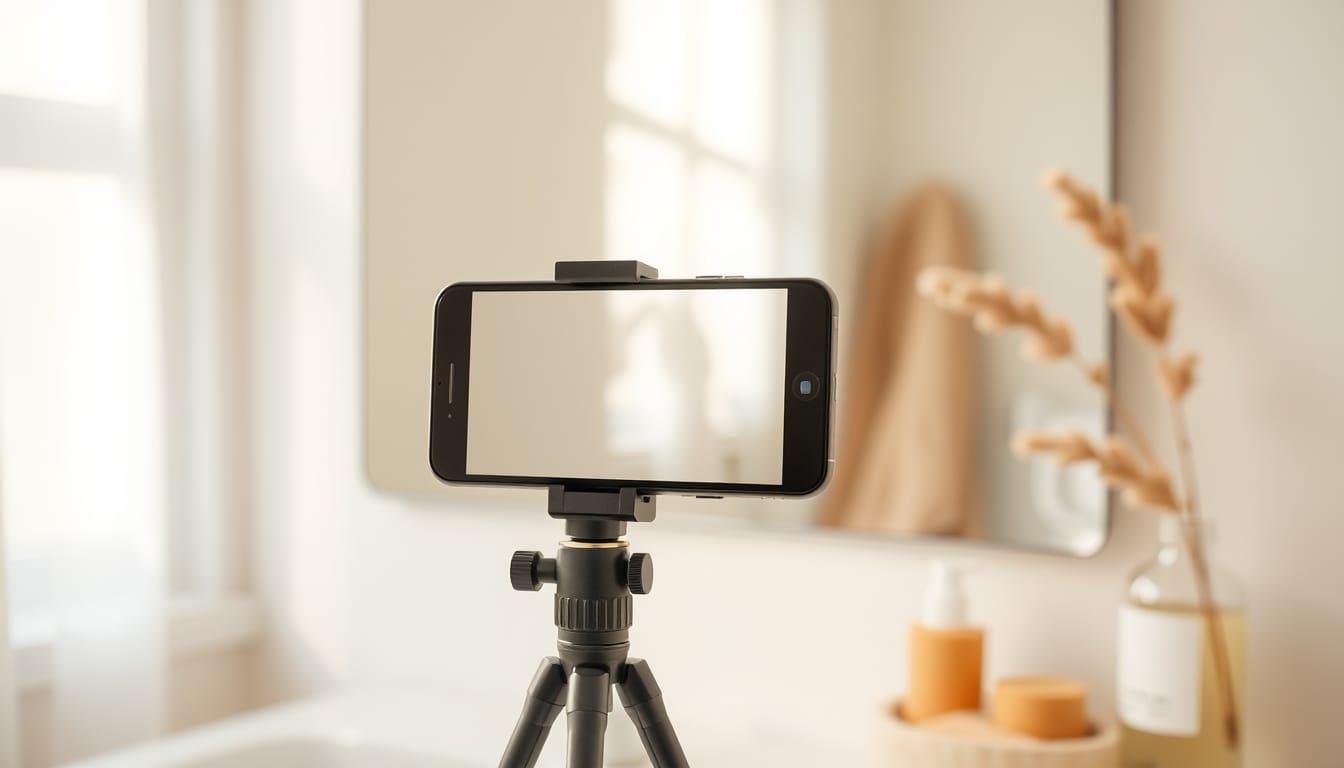
- Camera: use the same phone, the main lens at 1x, no portrait mode, filters or beauty settings. A small tripod or a stack of books holds the angle; a timer or remote shutter removes the shake.
- Distance: mark where the phone and your feet go with a strip of tape. A difference of a few inches changes how dense hair looks.
- Background: a plain wall or towel, so the hair edge is easy to see.
- Hair state: clean, dry, unstyled and product-free, ideally on the same day after washing each time. No fibers, tinted sprays or dry shampoo.
Which views should you shoot?
Pattern loss in men usually shows first at the temples, the front hairline or the crown. In women it more often shows as a widening part and thinning over the top, with the hairline intact. Shoot all five views regardless, because the pattern is not always what you expect, and a provider can only compare angles that exist from the start.
Front hairline
- How to shoot it
- Face the camera, head level, hair pushed straight back
- What it tracks
- Hairline position, density just behind it
Left and right temples
- How to shoot it
- Turn about 45 degrees each way, hair pulled back
- What it tracks
- Temple recession, the corners of the hairline
Top of the scalp
- How to shoot it
- Tilt the head down toward the camera
- What it tracks
- Mid-scalp density, how much scalp shows through
Crown
- How to shoot it
- Camera above and behind, using a timer or a helper
- What it tracks
- The whorl at the back of the head
Part line
- How to shoot it
- Center part combed straight, shot from directly above
- What it tracks
- Part width, the main marker of female pattern loss
| View | How to shoot it | What it tracks |
|---|---|---|
| Front hairline | Face the camera, head level, hair pushed straight back | Hairline position, density just behind it |
| Left and right temples | Turn about 45 degrees each way, hair pulled back | Temple recession, the corners of the hairline |
| Top of the scalp | Tilt the head down toward the camera | Mid-scalp density, how much scalp shows through |
| Crown | Camera above and behind, using a timer or a helper | The whorl at the back of the head |
| Part line | Center part combed straight, shot from directly above | Part width, the main marker of female pattern loss |
If you want to see where a hairline sits on the standard male scale, our guide to Norwood stages shows the reference patterns. Keep your face out of the frame for every view except the hairline if you prefer; it is the scalp that matters.
Wet or dry, long or short?
Dry hair is the standard, because that is how you and others see it. Wet hair clumps together and shows much more scalp, which makes it a harsh but sometimes useful stress test. If you want wet photos, take them as an extra set under the same rules and compare them only with other wet photos, never with dry ones.
Length matters more than people expect. Longer hair covers more scalp, and a fresh short cut can look like sudden thinning. Keep a similar trim schedule during treatment if you can, and note the date of each haircut in your log so a change in the photos is not mistaken for a change in the hair.
How often should you take them, and what do you compare?
Once a month is enough; weekly photos mostly record noise. Shoot on the same day of the month, at the same time of day, and keep a short log next to the photos: when treatment started, any change in dose made by your prescriber, illnesses, surgery, crash dieting or major stress. Those events can trigger a wave of shedding a few months later, covered in telogen effluvium and stress shedding, and the log stops you from blaming or crediting the treatment for it.
Month 1 to 2
- What is realistic
- Possible extra shedding as resting hairs are pushed out
- How to read the photos
- Not a verdict; see the shedding guide
Month 3
- What is realistic
- Shedding settles; first changes in some people
- How to read the photos
- Compare with baseline for stability, not density
Month 6
- What is realistic
- The usual point to judge whether a plan is working
- How to read the photos
- Side by side, same view; review with your provider
Month 12
- What is realistic
- A fuller picture of the response
- How to read the photos
- Compare with baseline and with month 6
| Point | What is realistic | How to read the photos |
|---|---|---|
| Month 1 to 2 | Possible extra shedding as resting hairs are pushed out | Not a verdict; see the shedding guide |
| Month 3 | Shedding settles; first changes in some people | Compare with baseline for stability, not density |
| Month 6 | The usual point to judge whether a plan is working | Side by side, same view; review with your provider |
| Month 12 | A fuller picture of the response | Compare with baseline and with month 6 |
The timelines come from the treatments themselves. Over-the-counter topical minoxidil labels say men may see regrowth from about 2 months and some need at least 4, and that women may need at least 6 months. Early shedding on minoxidil is common and usually temporary, as we explain in why minoxidil shedding happens. Untreated pattern loss tends to progress, so photos that look the same at 12 months as at baseline can be a meaningful result, not a failure.
How to compare photos fairly
Put two photos of the same view side by side at the same zoom, never one photo on its own. Pick landmarks and judge only those: how far the temple points sit from the eyebrows, how wide the part is at a fixed point, how much scalp shows in the crown whorl. Many phone gallery apps can place images next to each other; a simple grid overlay helps you line up the same spot.
Be suspicious of any comparison where the light, angle or hair state differs, in either direction. A flattering photo that was taken differently is as misleading as an unflattering one. If a set is clearly off, retake it rather than comparing it.
How to keep progress photos private
Scalp photos are health information. Most phones sync every image to a cloud account and show it in shared albums or memories, so a little care goes a long way.
- Move the photos into a locked or hidden album, or a separate app with a passcode.
- Check whether your gallery shares albums with family members automatically.
- Turn off location tagging for the camera, or strip it before sharing.
- Crop your face out of every view except the hairline if you prefer.
- Share them with a provider only through a secure patient portal, not by text message, email or social media.
When photos point to something else
Photos sometimes show a pattern that is not ordinary pattern hair loss: round bald patches, redness or scaling, a shiny scalp where follicles seem to be missing, broken hairs, or loss of the eyebrows along with the front hairline. Those signs can point to autoimmune or scarring conditions that need an in-person dermatologist, and the American Academy of Dermatology lists many causes beyond heredity. Sudden diffuse shedding after a trigger is a different situation again. In any of these cases, share the photos with a clinician rather than starting or changing treatment on your own.
How a provider uses your photos
Hair evaluations through telehealth are usually done from a questionnaire and photographs, without a live visit. A provider reads the pattern from your baseline set, asks about history and triggers, and decides whether a plan or an in-person referral fits. The same views at six months are how the provider judges whether the plan is working and whether anything should change. Consistent photos make that review far more useful. The men's hair program and the women's hair and skin program list what to upload and how the review works.
Common questions
How often should I take hair progress photos?
Once a month, on the same day and at the same time of day, is enough. Weekly photos mostly capture changes in lighting, styling and shedding rather than real progress. Compare monthly sets in detail at 3, 6 and 12 months.
Should hair be wet or dry in progress photos?
Dry, clean and unstyled is the standard, because wet hair clumps and shows more scalp. Wet photos can be a useful extra set, but compare them only with other wet photos taken the same way.
What angles matter most for hair loss photos?
The front hairline, both temples at about 45 degrees, the top of the scalp, the crown, and a center part shot from above. Men's pattern loss usually shows at the temples, hairline or crown; women's more often at the part and top of the scalp.
When will photos show a difference from treatment?
Usually not before three months, and the standard point to judge a plan is around six months, with a fuller picture at a year. Early shedding on minoxidil is common and usually temporary. Stability on photos can itself be a good result in a condition that normally progresses.
Why do my photos look worse some months?
Light, flash, distance, hair length, washing day and products all change how much scalp shows. Illness, stress or rapid weight loss can also trigger shedding a few months later. Check the setup and your log before concluding the treatment has stopped working.
Is it safe to send hair photos to a telehealth provider?
Send them through the provider's secure patient portal rather than by text, email or social media. Keep your own copies in a locked album and turn off location tagging. You can crop your face out of every view except the hairline.
Sources
- American Academy of Dermatology. Hair loss: diagnosis and treatment. Link (opens in a new tab)
- American Academy of Dermatology. Hair loss: 18 causes. Link (opens in a new tab)
- Baksanskaite J, Luu NC, Uribe NC, Trüeb RM. Standard operating procedures in trichological practice. Int J Trichology. 2025;17(2):147–150. Link (opens in a new tab)
- Cao N, Hu Y, Wang X, et al. Standardized clinical photography for improving dermatological treatment adherence: a scoping review. Clin Cosmet Investig Dermatol. 2026. Link (opens in a new tab)
- Minoxidil topical solution 5% for men: Drug Facts label (DailyMed). Link (opens in a new tab)
- Minoxidil topical foam 5% for women: Drug Facts label (DailyMed). Link (opens in a new tab)
- Penha MA, Miot HA, Kasprzak M, Müller Ramos P. Oral minoxidil vs topical minoxidil for male androgenetic alopecia: a randomized clinical trial. JAMA Dermatol. 2024;160(6):600–605. Link (opens in a new tab)
- American Academy of Dermatology. Do you have hair loss or hair shedding? Link (opens in a new tab)
- MedlinePlus (National Library of Medicine). Hair loss. Link (opens in a new tab)
This article is for general education and is not medical advice. Protocols described here require an online consultation with a licensed provider who will determine if a prescription is appropriate for you. Explore hair & skin options or read the FAQ.